Table of Contents
When Manningham Council adopted its revised Procurement Policy recently, it made a significant commitment.
The policy states that Council will "Champion Sustainable and Ethical Procurement" by engaging suppliers that demonstrate fair, ethical and socially responsible practices while meeting legislative and regulatory obligations relating to workplace safety, human rights and modern slavery.
Those are welcome words. The question now is what they will mean in practice when Council decides who receives public contracts.
That was the question fellow community representative Rita Manessis and I put to Council at its meeting on 28 July, following a year of advocacy by Menzies for Humanity and a petition supported by nearly 1,000 residents.
Our involvement began in 2025 when members of Menzies for Humanity met with the Mayor to discuss Council's procurement policy. We were advised at the time that the policy would be reviewed in 2026. Following Council's endorsement of the revised policy at the June council meeting, we submitted a petition reflecting the questions and concerns raised by local ratepayers about the companies and suppliers Council chooses to do business with.
Those concerns extend across a range of issues, including human rights, surveillance technology, and environmental and cultural harm.
One example raised with Council was Coles' partnership with Palantir Technologies, a US technology company whose clients include the CIA and the US Department of Defense. Under a three-year agreement, Coles plans to deploy Palantir technology across more than 840 supermarkets to collect and analyse worker data. This has prompted concerns about increasing workplace surveillance, the use of artificial intelligence and data security, particularly when the technology is intended to improve business efficiency during a cost-of-living crisis.
Another concern relates to Hewlett Packard, whose technology has been used by the Israeli government. Human Rights Watch and Amnesty International are among the organisations that have concluded Israel is committing crimes against humanity, including maintaining a system of oppression amounting to apartheid against Palestinians.
Outside the Council meeting, another example raised was security contractor G4S Australia. The company faced serious allegations over the treatment of asylum seekers and refugees at the Manus Island Processing Centre. G4S, together with the Australian Government and other contractors, ultimately paid $70 million in an out-of-court settlement to 1,905 detainees.
These examples illustrate the broader question facing Council: how does it determine whether a supplier meets the ethical standards it has committed to uphold?
The intention is not to suggest that Council can eliminate every ethical concern from its supply chains. In today's global economy, supply chains are extraordinarily complex and no organisation can realistically guarantee that every supplier is entirely free from controversy.
What Council can do, however, is establish a clear, transparent and consistent process for identifying significant ethical risks, particularly where concerns are credible, well documented, and where reasonable alternatives exist.
That is why the questions Rita and I asked on 28 July focused on implementation rather than individual companies.
We asked what criteria Council will use to assess suppliers against its new ethical procurement commitments, how frequently supplier audits will be conducted, and whether Council will publish both its evaluation criteria and a register of suppliers.
These are reasonable questions because the community deserves to know how Council intends to give practical effect to the commitments contained in its own policy.
Manningham may be only one local council, but it still has a responsibility to exercise due diligence in how it spends public money. Local government also has an opportunity to demonstrate leadership by ensuring ethical considerations form part of procurement decisions.
No one expects perfection. The expectation is simply that where there is credible evidence of serious harm, and where suitable alternative suppliers are available, Council has a transparent process for identifying those risks and taking them into account.
Ultimately, this is about accountability. An ethical procurement policy should not exist merely as a statement of intent. It should provide the framework for decisions that are transparent, consistent and capable of public scrutiny.
The petition has helped move the conversation beyond whether Manningham should have an ethical procurement policy. The challenge now is to ensure that the policy has substance.
For those of us who have supported this campaign, success will not be measured by the words contained in the Procurement Policy itself. It will be measured by whether those words are reflected in the decisions Council makes every time it spends the community's money.
Manningham Council responds
Manningham Life sought a response from Manningham Council regarding the issues raised in this opinion piece.
A Manningham Council spokesperson said:
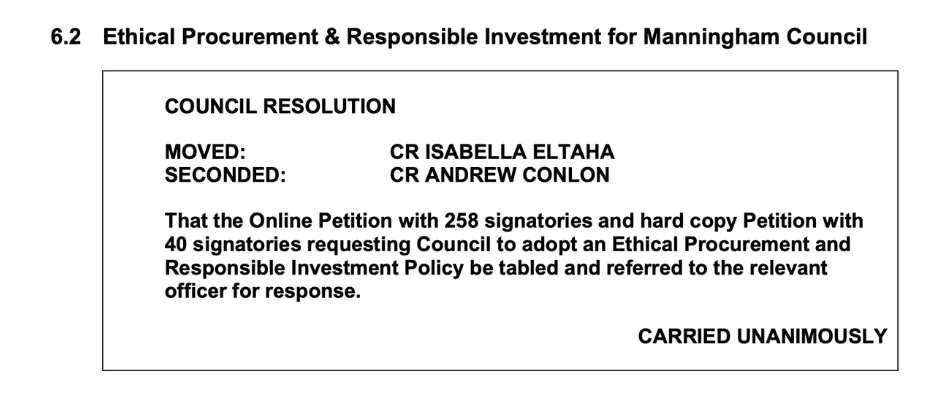
"At its meeting on 28 July, Council voted to receive a petition calling for an Ethical Procurement and Responsible Investment Policy which was referred to the relevant officer for a response.
We thank community members for raising issues that matter to them so Council can consider and respond to them.
We will respond to the lead petitioner and include our response in the agenda for the August Council Meeting, in line with our standard process."
The spokesperson added that Manningham Council's Procurement Policy follows the requirements of the Local Government Act 2020. According to Council, the policy supports sustainable procurement by considering social, economic and environmental impacts, promotes ethical purchasing, supports local businesses, and aims to achieve value for money when delivering services to the community.